

Exterior Window Shutters – Styles, Materials, Custom Options, and Installation Guide
You’re standing in front of your house, looking at the windows, and something feels off. The facade is fine – the paint is fresh, the landscaping is decent – but the whole front elevation looks flat. Unfinished. Like a face without eyebrows. That’s usually the moment homeowners start seriously thinking about window shutters exterior. And once you start looking, you realize how much variety there actually is: materials, profiles, mounting styles, colors, and custom configurations that can genuinely change how a house reads from the street.
This guide covers all of it. Not the glossy catalog version – the real breakdown of what each option actually means for your home, your budget, and your weekend installation project.
The style of shutter you choose matters more than most people expect. Get it right and the shutters look like they grew with the house. Get it wrong and they look like an afterthought you ordered online at midnight.
Louvered shutters are the most common type you’ll see on American homes, and for good reason. The angled slats give them visual depth, they work across a huge range of architectural styles, and they’ve been a standard feature on homes from Colonial to Craftsman for over a century. Traditional louvered shutters have fixed slats. Functional versions have movable ones. If you’re going purely decorative – which most homeowners are – high-quality exterior louvers are simpler, cheaper, and hold up better over time.
Panel shutters are flat or raised-panel designs that work especially well on Colonial, Federal, and farmhouse-style homes. A raised panel shutter has a three-dimensional quality that catches light differently throughout the day, which gives the window a more substantial look. Flat panel shutters are cleaner and more contemporary – they suit modern and transitional homes where you don’t want a lot of ornate detail.
Board and batten shutters are vertical planks held together with horizontal or diagonal battens across the back. They’re rustic by nature, which makes them a natural fit for cottages, farmhouses, and craftsman bungalows. But they’ve also shown up on more modern homes as a contrast element, especially in darker colors against light siding.
Bahama shutters – also called Bermuda shutters – are hinged at the top and propped open at an angle. They’re strongly associated with coastal and tropical architecture. They do offer some actual sun and storm protection, which puts them in a middle ground between purely decorative and genuinely functional.
Raised panel and board and batten styles tend to be wider relative to the window than louvered styles. That’s worth thinking about if your windows are close together or if you have narrow wall space between openings. The proportions matter enormously here. A shutter that’s too narrow for its window will always look wrong, no matter how good the material is.
Architectural shutters are a broader category that includes custom profiles, arched tops, and cutout designs – stars, hearts, pineapples, crescents – that add a specific regional or historical character. These are popular in New England, the Mid-Atlantic, and the South, where certain decorative traditions run deep. If your neighborhood has a strong architectural identity, matching that tradition usually produces the best result.
The rule most designers follow: shutters should be sized so that if you folded them shut, they’d actually cover the window. Most decorative shutters on American homes are undersized, which is one of the main reasons they look cheap even when they’re not.
The material your shutters are made from determines how long they last, how much maintenance they need, and how good they look after a decade of sun and rain. There are four main options in the current market, and each has a real trade-off profile.
Vinyl shutters exterior are the most widely sold option in the United States. They’re inexpensive, they don’t rot, they don’t need painting, and they’re available in dozens of colors. A basic vinyl louvered shutter for a standard double-hung window will run somewhere between $20 and $60 per pair, depending on size and profile. That’s hard to argue with on a budget project.
The honest downside: vinyl can look thin and hollow, especially on larger windows. It fades faster than other materials in high-UV climates – the American Southwest and Florida being the worst cases – and the color options, while numerous, tend toward the flat side. Vinyl also doesn’t hold paint well if you ever want to change the color, which limits your flexibility over time. For a rental property or a home where you’re prioritizing cost over curb appeal, vinyl makes total sense. For a higher-end renovation, you might want to look further.
Composite shutters exterior are made from a mixture of wood fiber and PVC or other polymers. They’re significantly more rigid than pure vinyl, they hold paint well, and they have a more substantial look and feel. They’re also more dimensionally stable than real wood – meaning they’re less prone to warping and swelling with seasonal humidity changes. Price range for composite shutters runs roughly $50 to $150 per pair, depending on profile complexity and size. That’s a meaningful step up from vinyl, but the quality difference is visible.
Polyurethane shutters exterior sit at the premium end of the material spectrum. Polyurethane is a dense foam material that’s molded into highly detailed profiles – it holds crisp edges and deep relief better than vinyl or composite. The result is a shutter that can genuinely replicate the look of carved wood without the maintenance. Specialized architectural manufacturers like Decorative Architectural Shapes produce high-density polyurethane profiles that don’t rot, don’t crack, don’t absorb moisture, and take paint extremely well. It’s also the heaviest of the synthetic options, which gives it a solidity that vinyl simply can’t match. Expect to pay $80 to $250 or more per pair for quality polyurethane shutters, depending on size and profile.
Real wood shutters are still available and still beautiful. Cedar and redwood are the traditional choices because of their natural rot resistance. But wood requires regular painting or staining, it’s vulnerable to moisture damage if the finish is neglected, and it costs more than any synthetic option. For historically sensitive restorations or high-end custom work, wood is often the right call. For most residential projects, composite or polyurethane gives you 90% of the look at a fraction of the maintenance commitment.
Color deserves its own mention here. Most manufacturers offer their shutters in 20 to 40 standard colors, with darker tones – black, dark green, navy, deep red – being the most popular for contrast against light siding. Custom color matching is available from some manufacturers, which matters if you have an unusual siding color or a specific historic paint palette you’re working with.
Standard shutters come in fixed widths and heights, and they’re sized to fit the most common window dimensions in American residential construction. If your house was built between 1950 and 1990 and has never been significantly renovated, there’s a reasonable chance standard sizes will work for you. But a lot of homes don’t fit that profile.
Older homes – especially pre-war construction – often have window openings that don’t match any standard shutter size. Arched windows, oversized picture windows, unusually tall double-hungs, and bay window configurations all create situations where off-the-shelf products either won’t fit or won’t look right. That’s where custom shutters exterior become necessary rather than optional.
Custom shutters are made to your exact specifications: width, height, profile, louver size, panel configuration, and color. Industry specialists like Decorative Architectural Shapes work directly with homeowners and builders to manufacture custom-dimensioned shutters, including precise radius tops and bespoke cutouts. Most manufacturers who offer custom work will ask you to submit window measurements – typically the rough opening or the glass dimensions – and they’ll calculate the shutter sizing from there. The standard rule is that each shutter in a pair should be half the width of the window opening, so that together they’d cover the glass if closed.
Arched top shutters are one of the most requested custom configurations. They’re made to match the radius of an arched window head, and they require precise measurement of both the arch height and the spring point – the point where the arch begins to curve above the vertical sides. Getting this wrong means the shutter won’t sit flush against the wall, which looks worse than having no shutter at all.
Cutout designs are another popular custom option. These are decorative shapes cut into the bottom panel of a board and batten or raised panel shutter – a common choice in New England and the Mid-Atlantic where regional traditions favor specific motifs. Some manufacturers offer a menu of standard cutout shapes; others will produce custom cutouts from a provided template.
Lead times for custom shutters vary considerably. Some manufacturers can turn around custom orders in two to three weeks. Others, especially smaller specialty shops doing hand-crafted wood or high-detail polyurethane work, may need six to eight weeks. If you’re working on a renovation with a deadline – a home sale, a specific event – factor that timeline in early.
Pricing for custom work depends heavily on material and complexity. A custom composite shutter in a non-standard size might cost 30 to 50 percent more than a comparable standard size. Custom polyurethane with arched tops and decorative cutouts can easily run $300 to $600 per pair or more. That’s real money, but on a house where the windows are a prominent architectural feature, the visual return is usually worth it.
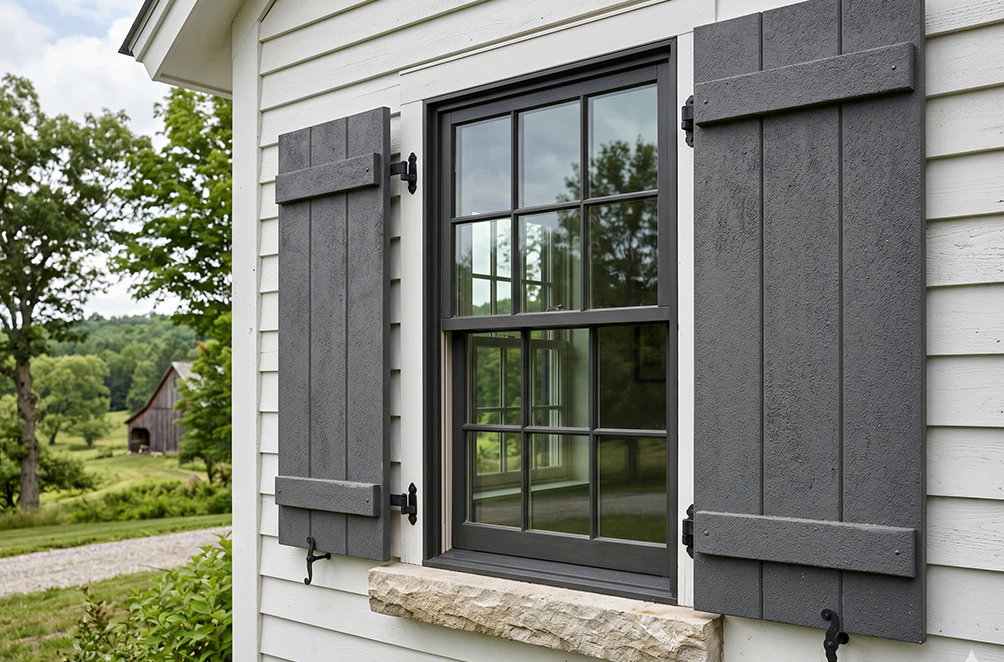
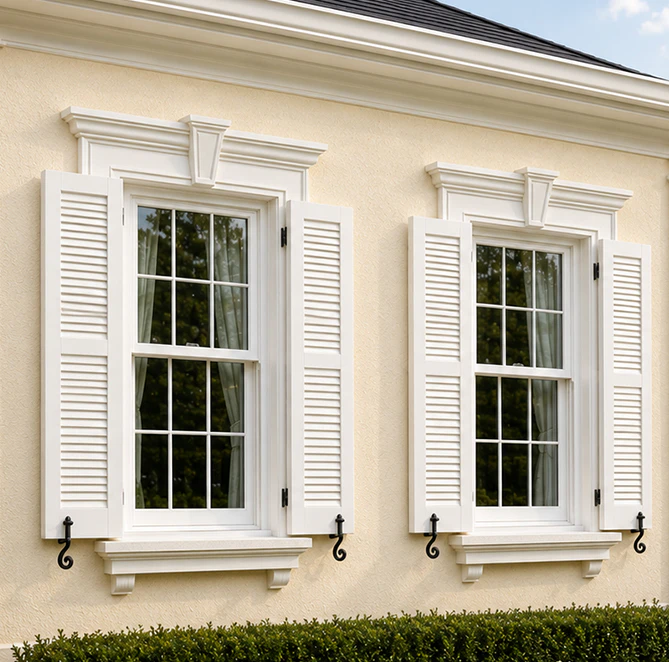
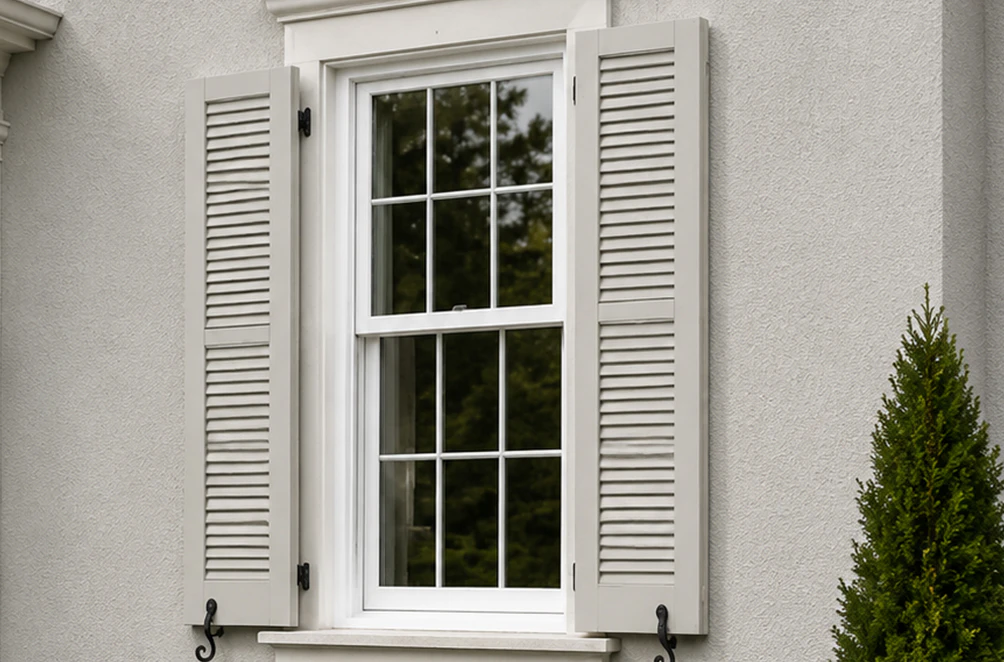
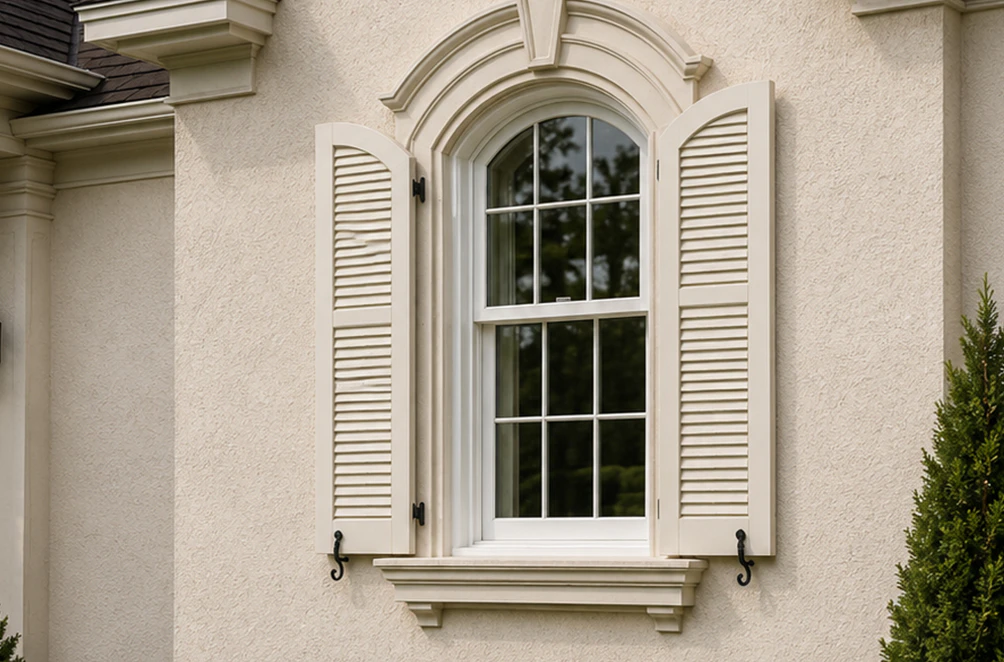
Most decorative shutters installation is a straightforward DIY project. You don’t need specialized tools or construction experience. But there are a few things that trip people up, and knowing them ahead of time will save you a frustrating afternoon.
Before you touch a drill, figure out what your exterior wall surface is made of. Vinyl siding, wood siding, fiber cement, brick, and stucco all require slightly different fastening approaches.
On vinyl siding, you’ll need to deal with the fact that the surface isn’t flat – the overlapping courses create an uneven mounting surface that will cause a flat shutter to rock or sit at an angle. The solution is shutter blocks or mounting blocks: small spacers that sit between the shutter and the siding at the mounting points, creating a level plane for the shutter to sit against.
For wood or fiber cement siding, direct fastening with exterior screws is usually straightforward. Use stainless steel or coated deck screws – standard zinc screws will rust and stain the siding within a couple of years. Pre-drill your holes, especially near the edges of composite or polyurethane shutters, to prevent cracking.
Brick and masonry installation requires masonry anchors or heavy-duty concrete screws and a hammer drill with a masonry bit. It’s more work, but it’s not difficult. The key is getting your anchor placement right before you drill, because masonry holes are permanent.
The standard mounting position is flush against the wall surface on either side of the window, with the shutter edge approximately half an inch from the window frame. Some installers prefer a small gap between the shutter and the frame for airflow and to prevent moisture trapping; others mount them tight. Either approach works – just be consistent across all windows.
Height alignment matters more than most people expect. The top of each shutter should align with the top of the window frame, not the top of the glass. On windows with decorative headers or crown molding, you’ll need to decide whether to mount above or below the trim, and that decision should be consistent across the whole house.
For a standard double-hung window on wood siding, the actual installation takes about 20 to 30 minutes per window once you have your materials ready. Two people makes it easier – one to hold the shutter in position, one to drive the screws. A level is non-negotiable. Even a shutter that’s off by two or three degrees will be visually obvious from the street.
Most vinyl and composite shutters come with mounting hardware included. Polyurethane shutters sometimes don’t, so check before you order. You’ll also want to pick up shutter locks or shutter dogs – the decorative holdbacks that prop a shutter against the wall and keep it from moving in wind. They’re a small detail, but they make the installation look intentional and finished rather than just slapped up.
Are exterior shutters functional or decorative?
Most shutters on American homes today are purely decorative. They’re fixed to the wall and don’t open or close. Functional shutters – the kind that actually hinge and cover the window – are still available and still used in hurricane-prone coastal areas, but they’re a minority. If you want functional shutters, make sure you’re ordering operable hardware and that your wall space can accommodate the open shutter panel lying flat against the siding.
What materials are best for shutters?
Vinyl is the budget choice – affordable and low-maintenance, but it can look thin and fades in high-UV climates. Composite gives you better rigidity and paint adhesion at a mid-range price. Polyurethane is the premium option: dense, detailed, durable, and excellent for painting. Real wood is still the top choice for high-end or historically sensitive projects, but it requires ongoing maintenance that the synthetic options don’t. The best material for your project depends on your budget, your climate, and how much upkeep you’re willing to do.
Can shutters be customized?
Yes, and it’s more accessible than most people assume. Many manufacturers offer custom sizing, arched tops, decorative cutouts, and color matching. You’ll pay more and wait longer than you would for stock sizes – typically 30 to 100 percent more depending on complexity, and two to eight weeks for production. But if your windows are unusual sizes or you’re working on a historically specific renovation, custom is often the only way to get a result that actually looks right.
Are shutters easy to install?
For most homes with wood or fiber cement siding, yes – it’s a straightforward DIY project with basic tools. Vinyl siding requires mounting blocks to handle the uneven surface. Brick and masonry need a hammer drill and masonry anchors, which adds some complexity but is still manageable for a careful DIYer. The main thing people underestimate is alignment: take your time with the level and measure twice before drilling, especially on masonry where mistakes are hard to fix.
Share the article
More architectural shapes
We provide architects, builders, and homeowners with turnkey decorative elements that transform any project — fast, easy, and cost-effective.
Have a project in mind?
Our dedicated specialists are ready to collaborate with you, turning your concept into a detailed plan with a transparent budget. Let’s bring your vision to life!

& specification catalog
Get the definitive guide to our custom decorative architectural foam shapes. This free catalog is packed with hundreds of design profiles, detailed technical specifications, and real-world project applications.